The application of microwave resonator perturbation method in the detection of molecular sieve carbon accumulation
Introduction
Molecular sieves are important solid acid catalysts. During catalytic reactions, deactivation can occur through several possible mechanisms: (1) Poisoning by adsorbates. Basic molecules act as poisons or inhibitors of acid sites; these molecules may be present as impurities in the feed or formed during the reaction. Deposition of metal ions from the feed can directly cover active sites or block the entrances to the catalyst micropores, causing severe deactivation. (2) Coke deposition. Carbonaceous species formed during the reaction deposit on the catalyst, covering active sites or narrowing/blocking pore mouths. This will be the main focus of this article. (3) Chemical changes of the catalyst itself. These mechanisms include (I) sintering, which can reduce the specific surface area and pore volume of the solid catalyst; (II) phase transformation of catalyst components; (III) sublimation or dissolution of active components; and (IV) chemical reactions among catalyst components or between the catalyst and reactants, converting the active catalyst into more stable but less active species.
"Coke" Deposition
"Coke" generally refers to carbonaceous materials formed during the catalytic conversion of hydrocarbons and deposited on the catalyst surface. According to Wolf and Alfani, "coke" is a collective term for mixtures of various hydrocarbons in which mono- and polycyclic aromatics are linked by aliphatic or naphthenic chains. Its composition and structure vary with the catalyst, reaction conditions, time, and the composition of the reactants. The formation mechanism of "coke" is extremely complex, involving numerous steps and reaction pathways, and differs greatly depending on the catalyst–reactant system.
"Coke" deposition is often accompanied by catalyst deactivation, although the two are not always parallel. Strong acids favor coke formation more than weak acids, and Lewis acids more than Brønsted acids. The presence of transition metals also accelerates coke formation. Deactivation caused by "coke" deposition can be roughly divided into direct and indirect mechanisms: (1) Direct mechanism—"coke" or its precursors form on active sites and irreversibly adsorb on them, thereby hindering reactants from participating in the reaction. (2) Indirect mechanism—"coke" deposits at the pore mouths of the catalyst, narrowing or completely blocking them, thus hindering the diffusion or entry of reactants into the pores.
Electromagnetic spectroscopy can detect "coke" formation. Combined with in situ infrared and Raman spectroscopy, the composition of "coke" can be roughly analyzed. However, spectroscopic techniques are mainly based on local analysis of molecular sieve samples. Combining with 13C solid-state NMR allows more comprehensive analysis of "coke" composition within molecular sieve channels, but solid-state NMR is costly and inefficient. Therefore, the authors of this work used the microwave cavity perturbation method to analyze "coke" in molecular sieves. This method is simpler and more efficient (Nature Communications, 2017, 8(1): 514, DOI: 10.1038/s41467-017-00602-8).
Paper Analysis:
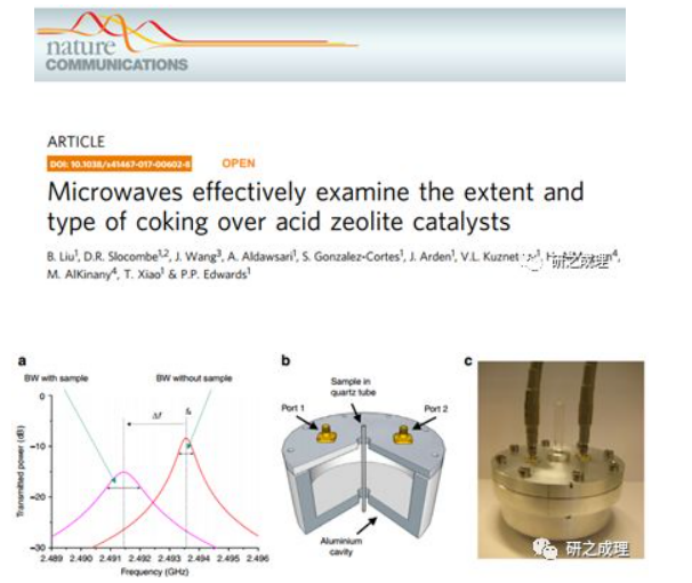
Figure 1. Schematic of resonance trajectory (a), and schematic of microwave cavity (b, c).
Dielectric loss ε" = ΔBW / (2f₀AVs), where ΔBW is calculated as shown in Figure 1a, A is a constant, Vs is the sample volume in the cavity, and f₀ is the original resonance frequency.
Note: The microwave cavity perturbation method is a technique for measuring the dielectric constant of materials. By measuring changes in the dielectric constant, the composition of a substance can be analyzed. Since coke and molecular sieves differ in dielectric constant, the microwave cavity perturbation method can be used to assess coke deposition in molecular sieves.
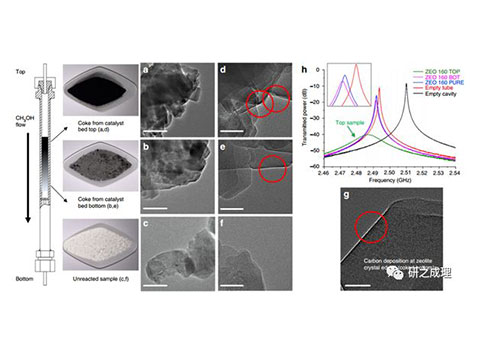
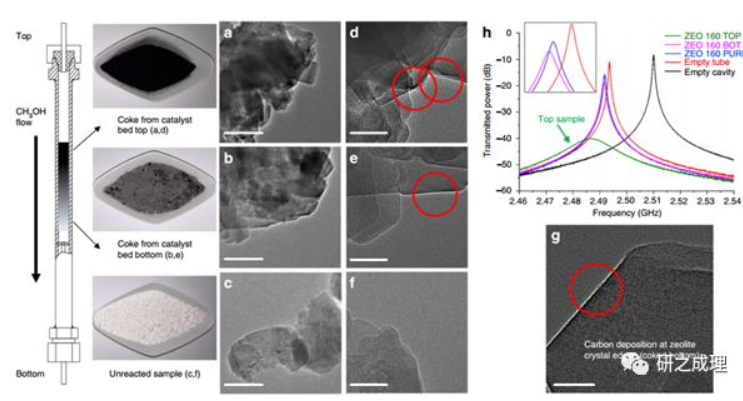 Figure 2. Transmission characterization and microwave curves of catalysts from different regions of the catalyst bed.
As shown in Figure 2, the ZSM-5 catalyst appears white (2c, f). After 5 h of methanol-to-hydrocarbons reaction, the upper part of the catalyst bed has more coke deposition and the darkest color. High-resolution transmission electron microscopy reveals obvious large dark coke regions (2a, d). The lower part of the catalyst bed has slight coke deposition, with a light gray color. High-resolution TEM shows scattered dark "coke" on the catalyst surface (2b, e, g). The microwave curves (2h) reveal that the resonance band shift of the upper catalyst with more coke is larger and broader.
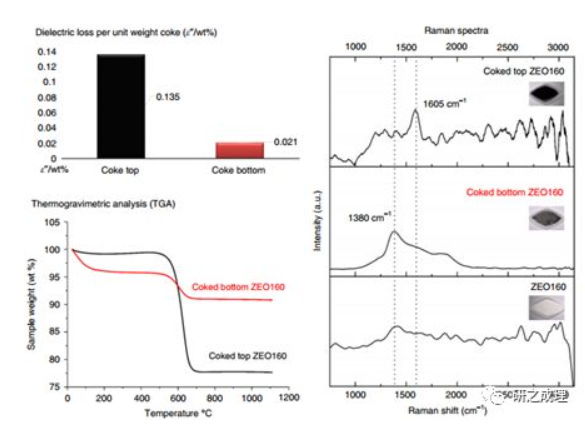
Figure 3. Dielectric loss per unit coke weight (ε"/wt%) data, along with thermogravimetric and Raman spectra.
As shown in Figure 3, Raman spectroscopy reveals a distinct characteristic peak at 1605 cm⁻¹ for the upper catalyst, indicating that the coke is mainly polycyclic aromatic hydrocarbons. For the lower catalyst, absorption is enhanced between 1300 and 1550 cm⁻¹, possibly due to olefinic or aliphatic hydrocarbon deposits. Combining thermogravimetric and dielectric loss data, the dielectric loss per unit coke weight (ε"/wt%) of the upper catalyst is 0.135, significantly higher than that of the lower catalyst (0.021).
Summary
The microwave cavity perturbation method can effectively and rapidly analyze coke deposition inside molecular sieve samples, providing better guidance for the industrial application of catalysts.